

An Overview of Pepperdine’s ABA Master’s Program
When you are choosing a master’s program in ABA, it can be difficult to decide which options are your best bet and which ones aren’t worth your time and money. Some programs may be cheaper but offer lackluster education and supervisory experience, while others may cost more but are accelerated, getting you to that BCBA exam seat quicker than others.
Let’s take a look at Pepperdine’s MS in ABA program to help you decide if this is the program for you!
Pepperdine’s MS in ABA program can be taken on campus in West Los Angeles or online. It typically takes around 16 months (4 terms), and classes are in the evenings. This is a quicker program than some of the other master’s programs in ABA, which means you can sit for the exam more quickly (provided you complete your fieldwork hours in a timely manner as well).
CBA modules (a must when studying for the BCBA exam) are available for students in the program. Although there is a fee associated with them, there are also scholarships to help offset the cost.
In 2024, 48% of first-time test takers from Pepperdine passed the BCBA exam. Graduates report that they felt prepared for the exam and that Pepperdine professors were incredibly responsive. From the sound of it, Pepperdine has a strong ROI, with a robust faculty and many opportunities for research.
However, the program is still quite expensive, with each credit hour costing over $1,600. Some potential students have opted for less expensive programs than Pepperdine due solely to the cost.
And, although the program is regionally accredited, it is not ABAI-accredited as of February 2026. You can check ABAI accreditation status here.
What Makes This Program Unique?
- You can attend this program either in person or online.
- The program consists of evening classes, so you can accrue fieldwork hours during the day at your ABA-based place of employment.
- You can graduate in as few as 12–15 months, making it one of the shortest MS in ABA programs out there.
- There are some good financial options for Pepperdine, including scholarship considerations for applying early.
Program Reviews and Feedback
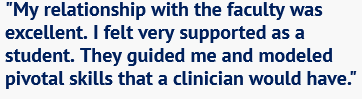
Some graduates highlight the importance of relationships with the faculty at Pepperdine. They felt the faculty prepared them for becoming a clinician.
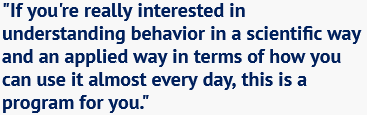
Other students recommend Pepperdine as a scientist-practitioner model.

Graduates report that the price is high but worth it, as the professors are incredibly responsive and good at what they do. The classes challenged them, but you can ask questions at any time.

Dr. Adel Najdowski, director of the ABA program at Pepperdine, got a shout-out from one student!
The ABA Program Curriculum
Students in the MS in ABA program at Pepperdine will take the following courses:
Semester I:
- Experimental Analysis of Behavior
- Measurement, Data Analysis, and Experimental Design for ABA
Semester II:
- Principles and Applications of ABA
- Ethical and Professional Conduct for ABA
- Practicum in ABA
Semester III:
- Behavioral Assessment and Intervention I
- Behavioral Assessment and Intervention II
- Supervision, Management, and Consultation in ABA
- Practicum in ABA
Semester IV:
- Radical Behaviorism
- Practicum in ABA
Students will conduct research and engage in practical hands-on training alongside faculty.
Pepperdine’s ABA Faculty and Research Expertise
Here is an overview of some of the faculty teaching in Pepperdine’s MS in ABA program:
- Dr. Adel Najdowski, BCBA-D, Professor
- Director of the MS in ABA program
- Serves on the board of directors of the BACB
- Used to be on the board of directors for CalABA
- Author of the amazing book Flexible and Focused: Teaching Executive Function Skills to Individuals with Autism and Attention Disorders
- Research/interests: diversity and justice, higher-order skills for autistic people, such as executive functioning skills
- Dr. Lusineh Gharapetian, BCBA-D, Assistant Professor
- Associate Program Director of the MS in ABA program
- Serves on the board of directors for CalABA
- Reviewer for the Journal of Organizational Behavior Management
- Research/interests: choice-making, OBM, diversity and inclusion, and clinical supervision
To look up additional faculty by name, please use Pepperdine’s faculty database.
Program Admissions Requirements
To apply, you must fill out the application and include:
- Official transcripts
- 2 letters of recommendation
- Statement of purpose
You must also hold a bachelor’s degree and reside in the United States. Note: GRE scores are not required for this program.
Tuition, Financial Aid, and Scholarships
As of February 2026, tuition is $1,630 per unit for the on-campus program and $2,030 per unit for the online program, and the program includes a total of 30 units.
Make sure to fill out the FAFSA to apply for loans. There are some internal scholarships for the program—students are automatically considered for them, so there is no extra application to fill out. If you apply early (see the website for details), you can be eligible for Ed for Life scholarships.
Graduate Career Outcomes
Graduates of Pepperdine’s MS in ABA program have become practicing BCBAs, clinical supervisors and directors, behavior consultants, care managers, and autism specialists. Others have gone on to get their PhD and become BCBA-Ds and professors or associate professors.
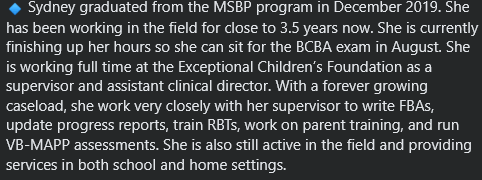


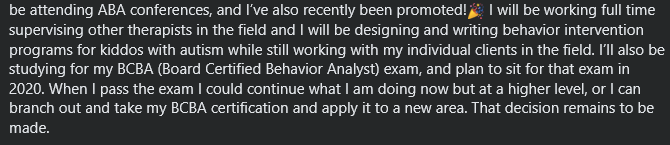
You can read more about graduate careers at Pepperdine here.
Pepperdine’s ABA Program Pros and Cons
Based on research I gathered from the website and graduates of the program, the following are some of the strengths and weaknesses of the Pepperdine ABA program:
Pros:
- You can earn the MS in ABA either on campus or online through Pepperdine.
- CBA modules are available for graduate students in the program. While you have a fee for these, there is also a scholarship to offset that fee.
- Most students receive some type of financial assistance. Applying early increases your chances.
- You can graduate in as few as 12–15 months.
Cons:
- The program is not ABAI-accredited.
- The tuition fee, especially for the online program, is relatively high.
- The BCBA exam pass rates are around the average rate overall.
Frequently Asked Questions
Does Pepperdine’s ABA Program Lead to BCBA Eligibility?
The MS in ABA program at Pepperdine (both online and on campus) meets BCBA Pathway 2 coursework requirements. You must meet additional requirements, such as fieldwork hours (which can be completed at your place of work) and passing the exam to become a BCBA.
Is Pepperdine’s ABA Program ABAI-Accredited?
Pepperdine’s ABA program is not currently accredited by ABAI (as of February 2026).
Can the program be completed online?
There is an online option for completing the MS in ABA program at Pepperdine.
Is the GRE required for program admission?
As of February 2026, no GRE is needed for the ABA program at Pepperdine.
What is the BCBA exam pass rate for Pepperdine graduates?
The BCBA exam pass rate for Pepperdine is relatively in line with the national average (around 54-60%). 48% of test takers from Pepperdine’s graduate program passed the BCBA exam on their first attempt in 2024, out of 108 graduates. In 2023, the pass rate for first-time test takers was 58% out of 101 graduates. BCBA exam pass rates by school program can be found here.